Ok I am not on drugs,
I wanted to start a topic about the process of "aging, stress relieving and stablising" an engine block. I am quite new to building engines so during mr research to gain more knowledge, I came across Bill Sherwoods site and saw that he left the block outside to weather and age as preparation before a build.
I though this was interesting and must be and old school trick? I can't find much information on the web (maybe I am using wrong works but "aging + engine block" doesnt go well together) but here is one I found that may help what I am thinking about.
http://www.moldmakingtechnology.com/...es/080101.html
So doing some stress relief by weathering / aging seems like a good idea? How do u do it properly. I would imagine leaving it out on in the rain wouldn't be a good idea.
aging is usually referring to a process where a precipitate phase grows over time.. ie aluminium alloys.. they are often heated to speed the natural aging process.
for cast iron blocks, some say that blocks settle over time.
seems a bit odd that a cast iron block would age outside, and not when being run at higher temperature in a car?
after casting, there may be some residual stresses, but if these actualy make any difference in service i cannot say (uually to do with bore roundness i suppose?)
stress relieving could be done by heating the block to some temperature that allows any dislocations to move around, and holding long enough for them ro either hit grain boundaries or otherwise tie themselves up.
doing this also risks damaging the block if thermal expansion actualy causes more stress than it is meant to relieve.. and then restresses itself upon cooling....
when searching, look for "cast iron" "stress relief" etc... aging will mostly just get you aluminium... ou could try seasoning? i suppose some oldies use that term![]()
"I'm a Doctor, not a mechanic"
"There is hardly anything in the world that a man can not make a little worse and sell a little cheaper" - John Ruskin (1819 - 1900)
AU$TRALIA... come and stay and PAY and PAY!!!
If you can find some info about Rolls Royce that would be a good start as they do this process by leaving there engines out in the weather.After each time they do any machining the engines go back out in the weather.
Cheers Brett.
There is a company/performance shop here in australia that has a mcahine to do what you are talking of. I can't remember the name though. BAsically, its a big table that you put the parts on and it vibrates the bed of teh table subsonically or something, basically shakes it back and forth at tiny high speed frequencies, kinda like ultrasonic cleaning of injectors. The harmonics and vibration let the parts settle over the coarse of a few hours from memory. I read an article on it in an old street machine or something, and they new engine blocks that the bores would move 2-3 thou and head surfaces needing resurfacing after treatment, so it definately does something.
Give someone like Trick and Manswetto a call. They build 1200+hp V8's and 8-900hp small blocks from brand new castings, they are among the best in the country and if they do it to their engines I'm sure they will tell you where to get it done, and if they don't, I can't see a need for it.
6BOOST![]()
I have seen cast plates move after machining. The greener they are the more they can move.I had one here for remachining that had moved 7MM over a length of 2.4 metres.
here is a scan from the machinerys handbook regarding seasoning of castings.
Jealousy is a curse
The original "M" series engin blocks used by BMW in the 2002 Turbo and there turboed F1 cars of the early 70's were left in the weather for over 6 months befor being built up into race motors.
There was even mith that the Engineers at the BMW plant would piss on the blocks while on smoko cause they believed it helped with the process.
....................................
I remember hearing/seeing this on a Doco i watched around 12 months ago, i taped it so ill see if i can get the name of the show.
From Tassie?
Join Up with ToyoTas Now - http://toyotas.proboards.com/ - The First Toyota Car Club in Tas
for the above mentioned bmws they also sourced all there racing blocks from wrecked taxis-i think that the block had to have done at least a million k's before they were interested in using them in racing motors.
GA23(never finished) JZX83 (Tyre eater) Turbo MX5 (Moment of weakness but awesome IMHO)
i read in a few different technical books that the repeated thermal heating and cooling from normal engine use seasons blocks. so if your using a non virginal engine block, the normal checks/machining should suffice.. all depends on the factory tolerances i spose.
BMW* reputedly stress-relieved the 4cyl blocks used in F1 turbos by setting them outside the workshops in the weather for many months to rust and generally be neglected ... they also reputedly sourced their 4cyl blocks from used bimmer engines.
* the above could be just folklore.. so it could be 100$% bullshit... but it makes for an interesting story![]()
Stress-relieving sure sounds like fun...pissing on blocks and beating them with wooden 6x4's poles![]()
On a serious note, would leaving them to rust be bad? Logic tells me rust is a bad thing? Or is there some secret behind this or just plain laziness?
I'm not on drugs either.Originally Posted by thanhngo
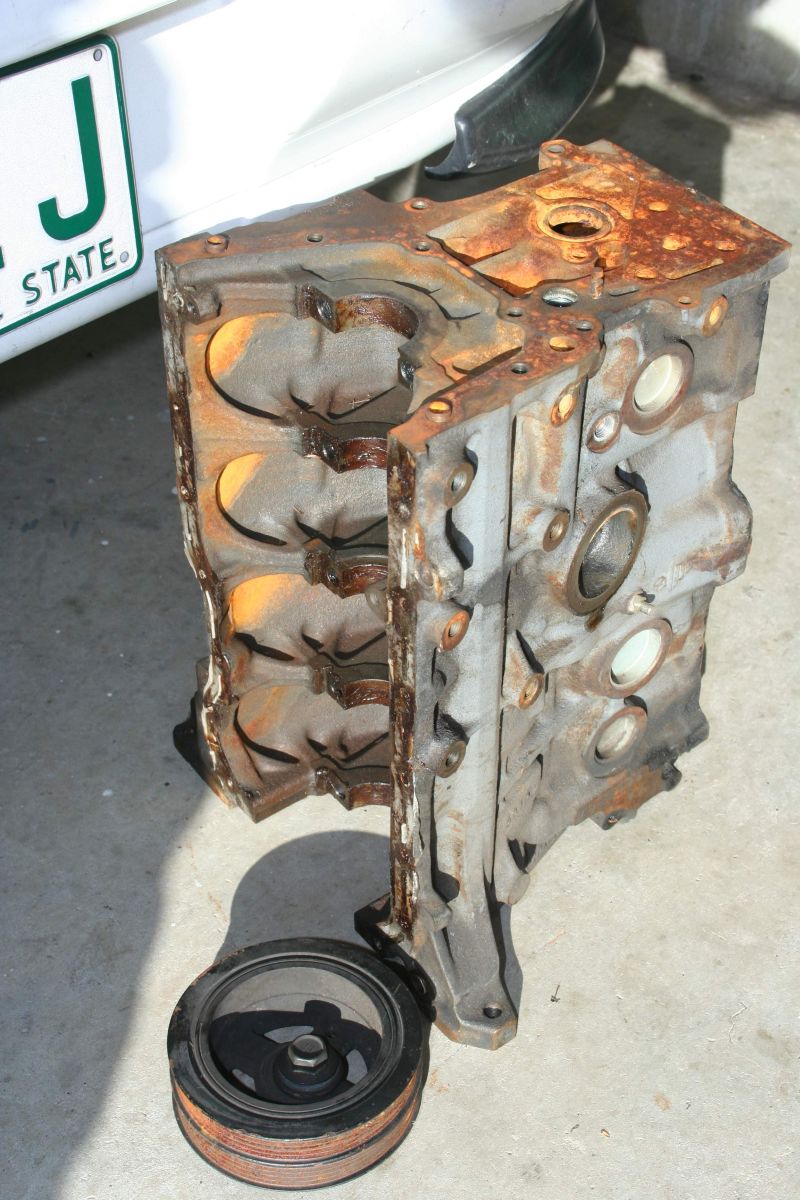
Yes, I left a 7A block outside in the weather for a couple of months to 'age'. I put some grease on the bits I didn't want to rust, and left the other sections I wanted to age or didn't really worry about uncovered.
Here's the block just before it went to the acid bath a couple of weeks ago for a cleanup.
As mentioned, I'm copying what BMW (and many others) have done to blocks to help stabilise them before giving them a hard time.
Can someone find some tech on this? I've been looking a bit
and haven't found much of what I'd consider proof except for slowing down the cooling process by keeping the mold in an oven. The biggest questions seem to be over 'Vibrational Stress Relief'.
http://www.eng-tips.com/viewthread.c...=126500&page=1
http://yarchive.net/metal/cast_iron_aging.html
I think we'd be seeing A LOT more abnormal main bearing wear if there was an ounce of truth in this!
I'll still consider it an 'old wives tale, or urban legend until there is something better to read.
wouldn't any aging effect taken place during the normal service life of the engine? To me it doesn't seem right that using an engine for 15 to 20 years and then leaving it outside will do anything to it at all.
yeah aging is done in use.
many race engine builders prefer to use a good 2nd hand crank instead of a new one.
work hardening is what a lot of ppl refer to it as.
leaving it sitting out side may help in some cases, i think it would depend on the climate.
i find it hard to believe that BMW would use a method that takes so long for a project where time is critical. i think a heating and cooling process would be better.
such as heating it to around 50-60c (some more research may find a better figure) let it air cool. and stick it in the fridge. and repeat.
or, just cyro treat it.
whats the engine? i would imagine its only needed for an extreme engine.
I DONT WORK FOR TOYOTA ANYMORE
please, no more PMs!
tech.
diffusion in metal, and intrinsic? movement of dislocations (unless loaded significantly), is very slow at room temperature, even in outside natural temperatures.
i could do some calculations to show how many orders of magnitude smaller it is at room temp than operating temp, but i don't have the time or inclination
to put it in perspective, at 1000 deg C, diffusion is kinda fast, maybe a few millimetres in a day/week (depending on material), but below 600deg, we consider diffusion to pretty much stop (relatively). 100 or even 150deg is a very low temperature for diffusion. (diffusion being one way to eliminate dislocations by freeing or locking them)
the idea is that there are residual stresses in the block after casting, and that the uneven relaxation of these in service could warp the block, affecting the bore roundness and position of the bearings.
this is true to some extent. 7M blocks may be a good example of this, with casting warpage over time affecting the trueness of the deck. (as well as bolt stretch or whatever)
the idea of the vibrational stress relief is to allow dislocation movement by producing local stress in the material insuch a way that the dislocations are made mobile again.
while this could work, finding the settings for frequency and amplitude that would equally affect a whole block, and then actually producing them, would be a challenge, since you may need to create internal forces in the block that are a significant proportion of the strength of the metal itself, in order to free the dislocations, or indeed, to actually produce deformation by vibration!! we are talking in the order or 10s or 100s of megapascals of force.
the idea of heating a block to "relax it" is:
to raise the temperature f the material to a point where the strength of the material is DECREASED past the strength needed to lock the dislocations. ie, weaken the whole block, so that the trapped stresses, in the form of dislocations, are made mobile, and deformation can take place.
if the internal stresses are large enough, you may induce a lot of deformation, and might even be bad enough to make block unusable?? i don't know if it would be that bad.
another point is, the operating stresses put into a block might also be a big contributor to block warpage, by causing this local overloading and stress relief, as opposed to the temperature of operation.
however, if you heat block before putting in service (or even machining it), then you might be able to just get rid of the worst dislocations/stresses, such that in service, the rest of the dislocations/stresses are relatively immobile = stable block.
my guess is that heating block for a fairly long time, at a modest temperature, before machining, will lead to a more stable block in service.
i don't think that leaving a block outside will have much, if any, effect, and that it was probably a tale spun by BMW and others at the time, or perhaps the word "seasoning" got confused over time with the conditions for seasoning of wood, which is indeed leaving it outside (or at controlled temperature and humidity).
cryo treating may have an effect, but the effects of cryo are not well understood aiui. you do induce stresses in the material, but at low temps, dislocations are not very mobile, and especially for steels, you may risk damage of part due to the ductile to brittle transformation (think titanic)
so much for this being a "quick reply"
"I'm a Doctor, not a mechanic"
"There is hardly anything in the world that a man can not make a little worse and sell a little cheaper" - John Ruskin (1819 - 1900)
AU$TRALIA... come and stay and PAY and PAY!!!
Originally Posted by oldcorollas
you mean if you smack it with a lump of ice youll shag it?![]()
btw, good write up.
I DONT WORK FOR TOYOTA ANYMORE
please, no more PMs!
i meant more that if it is cold, and goes thru the transformation, you sure as hell don't want to drop itand the forces present as residual stress might even break it!!
but.. whatever floats your boat (or doesn't as the case may be)
i haven't seen the movie btw![]()
"I'm a Doctor, not a mechanic"
"There is hardly anything in the world that a man can not make a little worse and sell a little cheaper" - John Ruskin (1819 - 1900)
AU$TRALIA... come and stay and PAY and PAY!!!
FWIW: When my rods were prept for there tour of dutyThey were sent by the machine shop to somewhere in victoria to be sonicly relieved after they had been shot peened.( the shot peen process can aparently cuase some stress in the rods from altering the surface) Which is what 6boost is talking about.
As for doing a whole block with this process.... im not sure if it is possible.
I can find out the name of the place that did it if anyone is keen.
Nah it's legit.Originally Posted by oldcorollas
But for sure, a prologed & controlled heating of the block will produce more reliable and predictable results.
FWIW, it's not uncommon for lathe makers to cast the beds, then leave them out in the fields for six months or so, rusting away. Then they're taken back and machined true.
They apparently stay more accurate that way.
fair enough
i suppose it is not unexpected with an unstable material like steel or iron
there will be some amount of relaxation naturally, regardless of temperature, but that is somewhat dependent on the way the material was processed.... i was assuming a good casting process with not much residual stress... for a crappily designed casting/block, it might do wonders
i reckon the lathe makers would be better off employing or consulting a metallurgist![]()
"I'm a Doctor, not a mechanic"
"There is hardly anything in the world that a man can not make a little worse and sell a little cheaper" - John Ruskin (1819 - 1900)
AU$TRALIA... come and stay and PAY and PAY!!!